

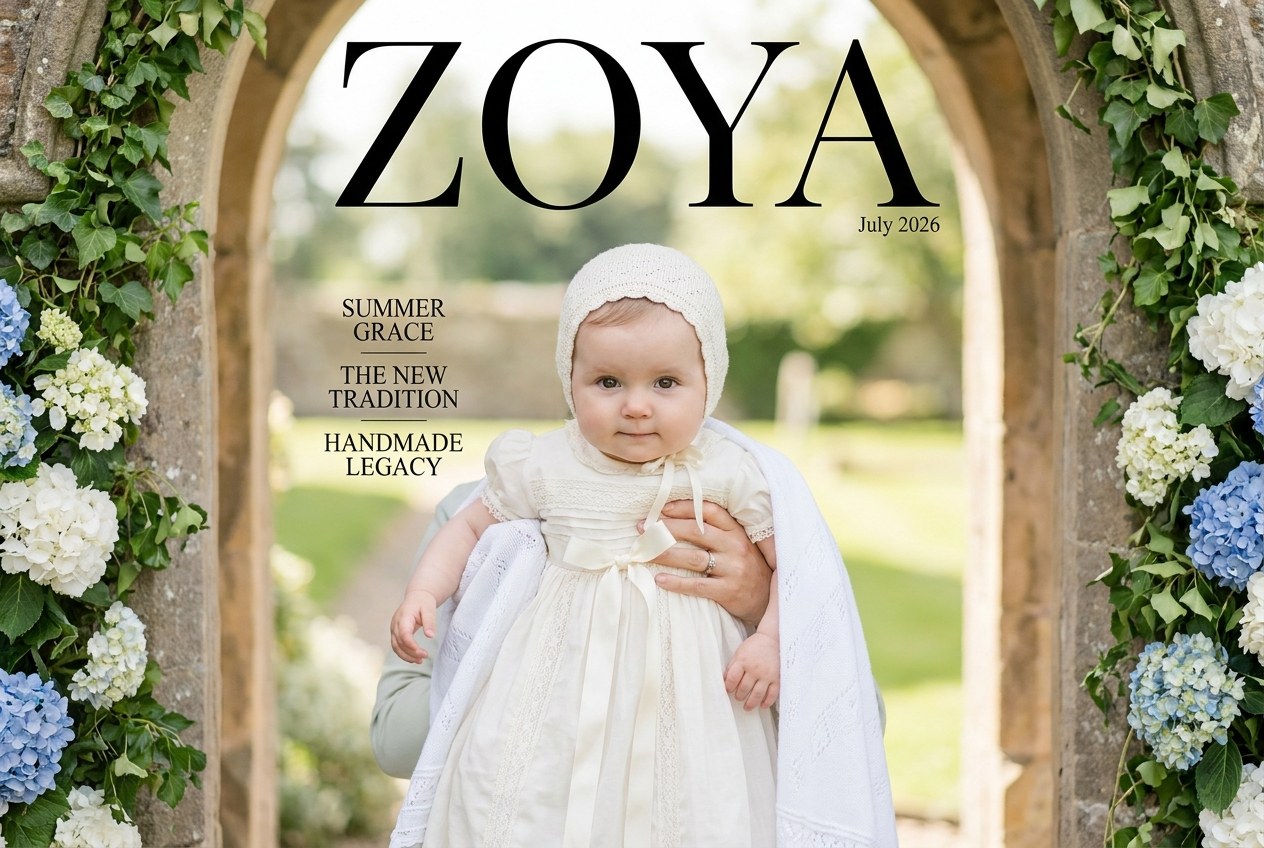
Christening Dresses for an Irish Summer: A Step-by-Step Plan for the Whole Day
The short version, in three points:
- Plan the day in blocks, not as one long event. A cool stone church, photos on the steps and then a warm garden are three different climates, and the outfit has to survive all three.
- Size up, and bring the safety net. Babies change shape between the day you order and the day you carry them up the aisle, so choose length and layers you can adjust.
- The changing bag is part of the outfit. A spare vest, a muslin over your shoulder and a bottle of water for you make more difference than any accessory.
There is a particular kind of quiet that lands on a family the morning of a christening. Someone is ironing in the kitchen, your mother is asking whether the church is the one beside the pitch or the other one, and in the middle of it all there is a baby who has no idea that today is about her. I remember it from my own daughter's christening six years ago, and I am living it again this summer as godmother to my sister's little girl, with a July date circled on the fridge and a six-year-old already asking if she can hold the candle.
If you are somewhere in that same swirl, this piece is for you. Not a lecture about what you should have organised in May, but a practical run-through of the day itself: how to pick between the christening dresses that photograph beautifully and the ones that actually work for four hours, how to time the church-to-reception gap, how to size a baby who is growing weekly, and what genuinely needs to be in the bag.
Why an Irish July Changes How You Choose Christening Dresses
An Irish summer is not a hot summer, and that is the most useful thing to accept before you choose anything. A good July day here sits around eighteen or nineteen degrees, with sunny spells, a breeze from nowhere and a shower that arrives exactly when everyone is arranged on the church steps. Then there is the church itself. Parish churches are stone, they hold the cold beautifully, and a building that feels blissfully cool to you at two o'clock feels genuinely chilly to a baby who has been lying still in your arms for half an hour.
So you are dressing for two temperatures at once, and the outfit has to move between them without a full change. That is what pushes me towards natural fibres every time. Cotton, cotton-blend and fine viscose breathe, and they do not turn clammy the way a heavy polyester lining does. If a dress is lined, run your hand inside it in advance. If it feels slippy and airless to you, it will feel worse against skin that has been in the same position for two hours.
The second July factor is who is coming. Late July and the August bank holiday weekend are when the family scatter comes home. Cousins fly in from London and Boston, someone drives up from Kerry, and the guest list quietly grows. That means more passing around, more photos and a longer day than you planned, so choose a fabric that recovers after six different shoulders and avoid anything that creases if you look at it sideways.
Finally, the season means daylight. A July christening can comfortably run until nine in the evening in a back garden, and the second half of the day is the part nobody dressed for. Keep that in mind when you look through christening dresses for girls — the winning one is the one that still looks lovely at seven o'clock.
Timing the Day: Church, Photos, Then the Garden
The part that catches most families out is not the ceremony. It is the gap. The ceremony is usually short and well run, but the stretch between the last blessing and the first plate of food is where a baby gets tired, hungry and overheated all at once, usually in front of an audience. Here is the shape most Irish christening days take, and what the outfit needs to do in each block.
| Time block | What is happening | What the outfit needs |
|---|---|---|
| Arrival, 20 to 30 minutes | Family gathering at the church, greetings, the sponsors sorting the candle | A light layer on top; the church porch is draughty |
| The ceremony, 20 to 40 minutes | Water at the font, the shawl or white cloth, the candle | Easy access at the neckline and head; nothing tight over the shoulders |
| Photographs, 15 to 30 minutes | The steps, the grounds, the group shot nobody can organise | Skirt that falls well when the baby is held upright; no scratchy trim at the face |
| Travel to the reception, 15 to 45 minutes | Car seats, sun through the window, possible nap | No stiff sash or back detail that presses into the spine |
| The reception, 2 to 4 hours | Food, being passed around, the cake, the garden | Breathable fabric, a cardigan or bolero for the evening dip |
Read across that table and one thing stands out. The dress is worn for a long time, but the ceremony is only a small part of it. Most of the day is car seats, arms and laps.
The two decisions that save you most stress
First, decide in advance who is holding the baby during photographs and tell that person. It sounds trivial. It is not. It stops the pass-the-parcel that leaves a dress creased and a baby unsettled before the group shot.
Second, agree the feed. Bottle or breastfeed, plan it for after the ceremony and before the photographs, not on arrival at the reception. A fed baby photographs like an angel, and no amount of styling fixes a hungry one.
Sizing a Baby Who Grows Between the Order and the Day
This is where I have watched more lovely plans come unstuck than anywhere else. You order in June for a christening in late July, and in those weeks a baby can move up a full size. Length in particular disappears faster than you expect.
My rule is simple. Go by current weight and length rather than the age on the label, then take the next size up if the baby is near the top of the range. A slightly roomy dress looks intentional and photographs beautifully. A slightly tight one looks tight in every picture, and presses on a tummy for four hours.
A three-point measure, taken twice
- Length from shoulder to below the knee, taken with the baby lying flat and relaxed, not stretched out.
- Chest around the fullest part, with a finger of ease, measured over a vest rather than bare skin.
- Head circumference, if there is a bonnet or headband, because this is the measurement that changes fastest of all.
Take those measurements when you order, then take them again roughly ten days before the day. That second check is the whole point. Ten days is enough time to swap a size or to shorten a hem, and not enough time to panic.
A few notes from experience. Long sleeves are more useful than they look in an Irish July: you can push them up in a warm garden, but you cannot invent them in a cold church. Buttons or ties down the back beat a narrow neck opening pulled over a head that does not want it. And if there is a matching bonnet, buy the headband too, because babies discover around week fourteen that bonnets come off. When you are browsing baby christening dresses, check the size chart against your own two measurements rather than trusting the age range on its own.
Heat, Showers and the Four-Seasons-in-One-Afternoon Back-Up Plan
Every Irish family knows the forecast that says sunny spells and scattered showers, which is a polite way of saying nobody knows. Rather than gambling, I build the outfit in three removable layers and stop worrying about the sky.
Layer one is the base: a soft cotton short-sleeved vest with no seams across the back where the car seat sits. Layer two is the dress. Layer three is a fine knit cardigan or light bolero in a matching tone, which comes off in the car and goes back on in the church. Three pieces, two of which come and go in ten seconds without undoing the main outfit.
The shower plan
Bring one large umbrella, not four small ones, and hand it to whoever is not holding the baby. Keep a lightweight blanket or wide shawl in the car rather than a rain cover, because you will be walking twenty steps to a door, not standing in weather. If photographs on the steps get rained off, the porch and the grounds under trees both work well, and the light is often kinder anyway.
The heat plan
On the rare hot day, the risk is not the sun, it is the car. A parked car heats quickly, so travel with the cardigan off and the window blinds down. In a garden reception, claim a shaded corner early and put the pram there before anyone puts a table on the spot. A damp muslin on the back of the neck cools a fretful baby faster than anything else I have tried.
One thing that is easy to forget in all this: you will be in the photographs too, holding the baby for most of them. Choose something you can feed in, bend in and carry a child in, and set it out the night before. The same logic that makes a good baby outfit makes a good adult one, which is why I look for softness and structure together when I go through girls' christening dresses for the family.
The Changing Bag Checklist for Christening Day
This is the list I keep in a note on my phone and copy across for every christening, communion and family wedding. Pack it the night before, because the morning belongs to other people.
- [ ] Two spare vests, not one, and one spare full outfit in a neutral tone
- [ ] Nappies for double the length of the day, plus wipes and a change mat
- [ ] Muslins, at least three, and one folded over your own shoulder before every photograph
- [ ] The feed: bottle, formula, cool boiled water, or whatever you need away from the crowd
- [ ] A small stain pen and a clean white cloth for the inevitable
- [ ] The cardigan or bolero, packed even if the morning is warm
- [ ] Age-appropriate sun cream, plus a soft wide-brimmed hat
- [ ] The christening candle, the white cloth or shawl, and anything the parish asked you to bring
- [ ] Baby paracetamol if teething is in full flight, and any prescribed medication
- [ ] A dummy, a familiar comforter, and one quiet toy that does not make noise in a church
- [ ] Phone charger and power bank, because everyone will be filming
- [ ] Water and a snack for yourself, which you will forget and then be glad of
The three-bag system
Split it. One small bag stays on your shoulder in the church with nappies, wipes, one muslin and the dummy. A larger bag lives in the boot with the spare outfit and the back-ups. A third, clearly labelled, holds only the candle and the shawl, and goes to one named person whose sole job is to hand it over. Three bags sounds like more work. In practice it means you never rummage through a full changing bag in a quiet church while forty people watch.
Your Calm Plan for a Beautiful Day
If you take nothing else from this, take the shape of it. Dress for a cold church and a warm garden with three light layers instead of one heavy one. Measure your baby twice, ten days apart, and choose the size that gives room rather than the one that just about fits. Plan the feed for the gap between the ceremony and the photographs. Pack the bag the night before and split it in three. Then let the day happen, because it will be lovely whether the group photo is on the steps or in the porch.
And that is the whole thinking behind good christening dresses: not the fanciest thing on the rail, but the one made in a fabric that breathes, cut so a baby can be lifted and held and passed around all afternoon, and finished well enough to become the piece someone keeps. When you are ready, take a quiet twenty minutes and browse the full range of christening dresses for baby girls with your measurements beside you. That is all the preparation the dress itself needs. The rest of the day is yours to enjoy.
Read also:
- Elegant Christening Dresses for Girls: A Style Guide
- Christening Dress Trends for Girls in 2025: Style & Comfort
- Summer Dresses for Girls: Top 2024 Styles for Irish Weather
- 5 Essential Occasion Dresses for Irish Girls' Capsule Wardrobe
- A family photo shoot with a photographer - what should children wear to make the photos look beautiful?