

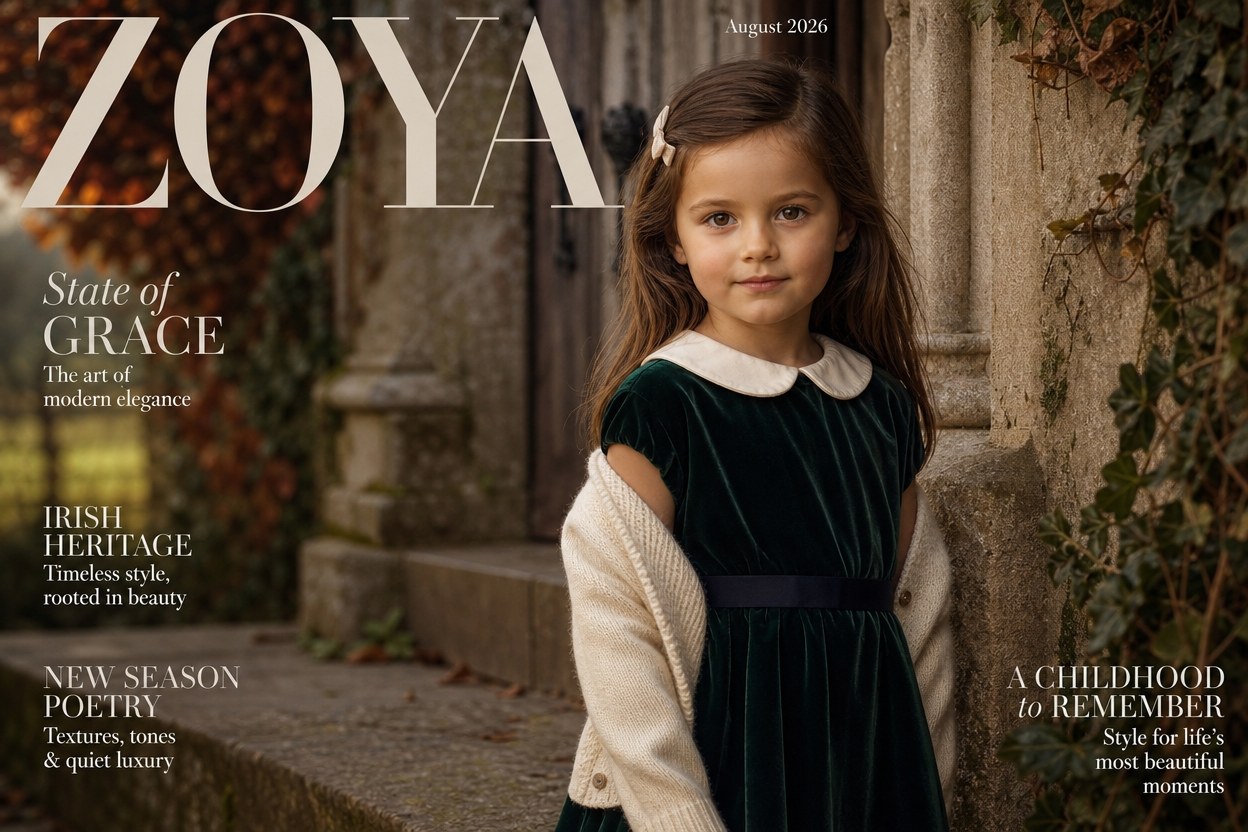
The Great Bow Reckoning: A Critic's Verdict on Hair Bands and Hairpins for an Irish Autumn
It is twenty past eight on a Tuesday morning in the last week of August, in a kitchen outside Kilkenny that smells of toast, hairspray and low-grade panic. Laid out on the table like evidence at a trial are the family's hair bands and hairpins: a bow the size of a side plate in wine-coloured velvet, a navy grosgrain band, two pearl-tipped pins that have already lost a pearl between them, and a single satin clip in oyster. The school photographer is booked for ten. The child in question is five, has firm views, and wants the biggest bow. Her mother is thirty-nine, has fewer views and more coffee. I am standing in the doorway with a notebook, doing what critics do at moments of genuine crisis: nothing useful whatsoever.
Let me state my position early, because a critic who hides her verdict until the last paragraph is really only keeping a diary. The girls' hair accessory is the most over-styled detail in the entire Irish autumn calendar, and the single fastest improvement available to any family this September is restraint.
The Morning That Decides Everything
Irish autumn does not ease in politely. Most primary schools here reopen in the final days of August, so the wardrobe changes gear in a single week: one Friday the child is in a swimsuit on a beach in Kerry, the following Wednesday she is standing at a school gate in a jumper, being photographed. Between those two mornings sits a small, unglamorous test that no lookbook ever mentions.
The four-hour test
Ask yourself the only question that matters at half eight: what actually survives? Not what looks best on the table, not what photographs well on a smooth-haired model under studio lights, but what is still in place at midday after a coat has been pulled over the head twice, a yard has been crossed in an Atlantic wind, and a jumper has been dragged off during PE. In my experience the survival rate is brutal. The oversized bow on a thin elastic band pivots forward within the hour and spends the rest of the day sitting at an angle that makes an otherwise composed child look faintly bewildered. The band that grips well enough to stay put usually grips hard enough to leave a red line above the ears by lunchtime. Meanwhile the humble clip, anchored into an actual plait, is often the only thing that has not moved.
There is also the matter of framing. A school portrait is a head-and-shoulders crop. Whatever is in the hair occupies perhaps a third of the visible frame, which means scale is not a stylistic preference here, it is arithmetic. Choosing among hair bands and hairpins for girls with that crop in mind is a completely different exercise from choosing them in a shop mirror, where the child's whole body provides a sense of proportion that the camera will simply delete.
Exhibit A: The Oversized Bow in the Dock
I want to be fair to the bow, because I have been unfair to it in print before and received the letters to prove it. A well-made bow is a genuinely beautiful object: double-looped grosgrain with a crisp knot, edges heat-sealed so they do not fray, a tail that falls rather than sticks out. Worn by a six-year-old with a low ponytail and a plain navy dress, it is one of the most charming things in children's dress, and it has a long and respectable history that has nothing to do with anybody's social media feed.
The problem is not the bow. The problem is the arms race. Somewhere in the last few seasons the bow stopped being a finishing touch and became the entire proposition, until we arrived at accessories wider than the child's face, stacked in threes, in fabrics chosen for how they catch a ring light rather than how they behave in Irish weather. Is a bow that requires its own comb and a supporting cast of grips really an accessory any more, or has it quietly become the outfit, with the dress demoted to background?
Three practical objections, offered in the spirit of construction. First, proportion: a useful rule is that the bow should sit within the width of the child's own palm, and for a portrait, narrower again. Second, fabric: velvet reads beautifully as autumn but crushes at the knot and never fully recovers, while stiff polyester satin throws a hard white flare straight back at a camera flash. Grosgrain, cotton and matte satin all behave. Third, engineering: weight wants an anchor. Anything substantial belongs on an alligator clip fixed into a plait or a twist, never on a thin elastic that will migrate steadily backwards all morning like a very slow tide.
Exhibit B: The Discreet Satin Clip
Now the case for the defence, and the piece I would actually buy. The discreet satin clip is the most underrated object in the children's accessory drawer, precisely because it is designed to disappear. Its whole ambition is to hold a section of hair back from a face and then say nothing further. In a well-composed look it functions like punctuation: you register the sentence, not the comma.
There is real craft in the good ones and it is worth knowing what to look for. A quality clip has a lining on the metal so it does not snag, a spring with enough tension for fine hair, and a satin finish that is matte rather than glassy. Fine, soft, baby-fine hair, which an enormous number of Irish children have well into primary school, defeats cheap clips entirely, and the answer is usually a smaller clip with better tension rather than a larger one with more decoration. For updos, spiral pins and U-pins hold far better than straight pins, which slide out of soft hair the moment a child runs.
Then there is the styling grammar, which is where restraint pays visibly. Do not match the accessory to the main colour of the dress; the exact match flattens the whole look and makes both pieces read as a costume. Match it instead to a secondary note: the sash, the trim, the ribbon at the waist, the buttons. Or go a quarter tone off, an oyster clip against ivory, a soft sage against a deeper green. Anyone building a wardrobe from a range of satin clips and slides for girls should buy in pairs and in neutrals first: oyster, ivory, navy, black, a soft blush. Those five will carry an entire autumn of dresses. The novelty pieces can come later, and they can come one at a time.
Hair Bands and Hairpins in September Wedding Light
September is the busiest stretch of the Irish wedding year, and it flatters everybody. The light in the second half of the month drops low and gold, softens edges, and forgives a great deal. It does not, however, forgive glitter. This is the single most common error I see in flower girl styling: a crystal-encrusted band chosen under shop lighting, then photographed in a dark church interior where the flash turns every stone into a small white star, and again at six in the evening in a hotel garden in Wicklow where the low sun does exactly the same thing from the other direction.
What works in that light is texture rather than shine: matte satin, fine velvet ribbon, a single freshwater pearl, a knotted band in the same fabric family as the dress. If there are fresh flowers in the styling, keep them to one side of the head and keep them small; a full circlet on a five-year-old at a September wedding tends to photograph as a costume rather than a compliment to the bride. And a small logistical note that has saved more than one afternoon: buy two identical clips and put the spare in an adult's bag. Why do we plan the dress six months out and the hair accessory in the car park?
The christening postscript
Early autumn is also quietly christening season here, with families gathering after eleven o'clock Mass and photographs taken at the church door in whatever weather is going. For a baby, the rules change entirely. Nothing tight, nothing elastic that leaves a mark on a soft head, no hard bands and no clips at all on very fine infant hair. A soft knotted band in cotton or fine jersey is the whole permissible vocabulary, and honestly it is enough. For an older sister in the same photograph, choose occasion hair accessories that echo the baby's gown at a distance rather than matching it exactly. Sisters in identical accessories read as a set; sisters in a shared palette read as a family.
When the Evenings Turn
By the last week of September the evenings have gone properly cool, and the whole styling conversation changes because the fabrics underneath it change. A dress that was worn bare-armed in August now arrives with a cardigan over it, tights instead of ankle socks, and quite possibly a wool coat by the school run. The accessory has to talk to wool now, not to organza.
That shift argues for texture over polish. Velvet ribbon, corduroy-covered bands, cable-knit textures and matte grosgrain sit beautifully next to a chunky Aran cardigan or a tweed pinafore, while high-shine satin beside heavy wool looks like two different afternoons stitched together. The autumn palette helps: deep green, burgundy, mustard, chocolate, soft camel and the greys that this country produces in such abundance. And then there is the soft day, our national euphemism for persistent drizzle, which is a genuine material test. Satin water-spots. Velvet flattens and stays flat. Grosgrain and cotton dry out and carry on. There is also the hood problem, which nobody warns you about: an oversized bow and a raincoat hood are natural enemies, and the hood always wins. So why do we keep buying for the photograph rather than for the walk to the car in the rain that happens immediately afterwards? A piece that has to be removed the moment the weather turns is not really autumn styling at all, it is a prop for a very short window of dry weather.
If you are buying for the season rather than for a single occasion, the sensible approach is a small rotation of autumn hair bands in wearable colours, plus two good clips, rather than one spectacular piece that suits precisely one dress on precisely one dry Saturday.
The Verdict in Five Points
I promised a verdict, so here it is, with the reasoning compressed and my usual self-indulgence set aside.
- Scale before decoration. For a school portrait, keep the accessory within the width of the child's palm. The crop is head and shoulders, and the camera has no sense of proportion that you do not give it.
- Engineering before beauty. Weight needs an anchor. Substantial pieces go on lined alligator clips fixed into a plait or twist; thin elastic bands are for light pieces only, or for nothing at all.
- Matte before shine. In dark churches and low September sun, texture photographs and glitter flares. Choose matte satin, fine velvet and a single pearl over crystal.
- Neutrals before novelty. Five well-chosen neutrals in oyster, ivory, navy, black and blush will dress an entire autumn. Build the collection from that base and add the statement pieces slowly.
- A quarter tone off, never an exact match. Echo the sash, the trim or the buttons rather than the main colour of the dress, and let the dress do the talking.
The child in the Kilkenny kitchen wore the oyster satin clip in the end, on a low side plait, with the wine velvet bow travelling to school in her bag as a negotiated concession. In the photograph her face arrives before anything else does, which is the entire point and the reason I keep writing about this. Choose your hair bands and hairpins the way you would choose a good pair of shoes: for the morning they actually have to get through, not for the shelf. If you are restocking before the photographer, the wedding or the christening, browse the full range of hair bands and hairpins and buy the quiet ones twice.
Read also