

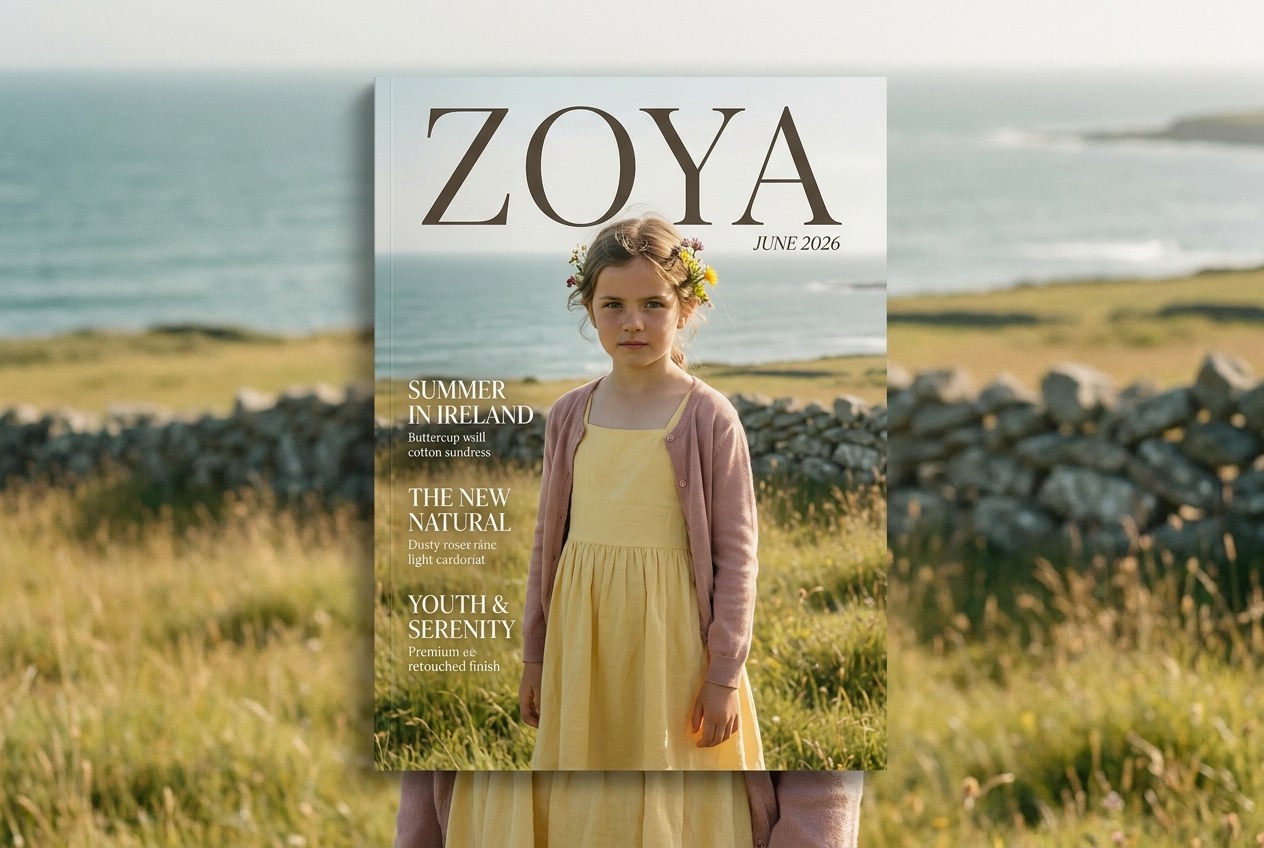
The Quiet Revolution of the Everyday: Why Girls Casual Dresses Are the Most Underrated Wardrobe Story of an Irish Summer
Let me set the scene. It is half seven on a Saturday morning in a kitchen somewhere outside Galway, the kettle is wheezing, and a six-year-old has just declared, with the unshakeable conviction of a small monarch, that today she will be wearing "the twirly one." Not the good one kept for Mass. Not the stiff one from the christening. The twirly one. The one that lets her sprint across a wet field, climb the garden wall, eat a 99 sideways, and still look, somehow, completely put together. That, dear reader, is the genius of the everyday dress, and it is the quiet hero of this entire essay. I have spent years writing about flower girl silks and Communion lace, and yet I keep returning to a humbler truth: the dresses that matter most are the ones a child actually chooses to live in. The finest selection of girls casual dresses is not about occasion. It is about freedom dressed beautifully.
So why do we so rarely give the casual dress its due? Why does the wardrobe story always get told from the wedding back, never from the Tuesday forward? And what would happen if, just once, we treated the everyday with the same reverence we reserve for the once-a-year?
The Backstage Truth: What "Casual" Really Means in a Child's Day
I want to take you backstage for a moment, because that is where I learn the most. Not the runway, the backstage. The chaos of dressing rooms, the safety pins, the mother holding a juice carton at arm's length so it will not detonate over white cotton.
What I have noticed, season after season, is that the word "casual" has been quietly mistranslated into "careless." It is anything but. A truly excellent everyday dress is an engineering feat disguised as nonchalance. The hem must be long enough for modesty on the swings but short enough not to drag through a puddle on the way home. The fabric must breathe in a sudden June heatwave yet hold its shape through a cold snap that arrives, as Irish weather does, without an appointment.
The illusion of effortlessness
There is a phrase in tailoring, sprezzatura, the studied art of looking as though you made no effort at all. Children are the original masters of it. A little girl in a soft jersey dress with a gathered waist looks effortless precisely because someone, somewhere, thought very hard about the cut. The seams that do not chafe. The neckline that does not gape when she bends to inspect a worm. The pockets, oh, the sacred pockets, into which go conkers, hair clips, and the occasional reluctant snail.
This is why I find myself returning to well-considered girls casual dresses again and again. They carry the discipline of fine dressmaking into the territory of the ordinary, and in doing so they elevate the ordinary into something worth photographing. Is that not the whole point of good design, to make the everyday feel a little bit special?
Reading the Irish Summer: Why Girls Casual Dresses Must Expect Four Seasons Before Lunch
Let us be honest with one another about the climate. An Irish summer is less a season than a rumour. The forecast promises sun; the sky delivers a committee meeting of clouds, drizzle, a brief glorious blaze of warmth, and then a breeze straight off the Atlantic that means business.
A casual dress built for this island, therefore, is a different creature entirely from one designed for a Mediterranean holiday. It must layer gracefully. A cotton pinafore over a long-sleeved top in the morning becomes a standalone sundress by two o'clock and welcomes a cardigan again by the school gate at half three.
Fabric is character
I always tell parents that fabric is not a footnote, it is the whole personality of the garment. Breathable cotton and soft cotton blends are the backbone of a sensible summer wardrobe here, forgiving of grass stains and friendly to a hot wash. A little stretch in the weave means a dress moves with a cartwheel rather than fighting it.
Colour, too, deserves a thought. The Irish landscape is generous with its greens and greys, so a child in soft buttercup, dusty rose, or a clean nautical stripe reads beautifully against it. There is a reason these tones photograph so well at the beach in Lahinch or the park in Phoenix. They belong here.
When I browse the everyday options at girls casual dresses, I am quietly assessing exactly this: does the piece understand its weather? Will it survive a soft day, that gorgeous Irish euphemism for persistent rain? The best ones do, and they do it without ever looking like they are trying.
The Age Question: Dressing a Toddler, a Schoolgirl and a Tween Without Losing Your Mind
Here is a question I am asked more than any other, usually with a faint note of despair: how do I dress a four-year-old and a ten-year-old from the same wardrobe philosophy without one looking like a doll and the other like a teenager in training?
The answer is that casual dressing scales with childhood far more gracefully than occasionwear ever could. Let me walk you through it, the way I would over a pot of tea.
Toddlers (roughly two to four)
At this age, the brief is movement and dignity intact. Smock shapes, easy poppers at the shoulder, nothing that requires a degree in engineering to get over a wriggling head. The dress should survive the indignities of toddler life and emerge, after a wash, ready to go again. Decoration should be felt, not just seen, soft appliqué rather than anything scratchy.
Schoolgirls (five to eight)
This is the golden age of self-expression. She has opinions now, loud ones, and the wise parent leans into them. Offer a small, curated range and let her choose. A-line shapes, tiered skirts that twirl, stripes and gentle florals. The dress becomes a costume for her own imagination, and that is a gift, not a battle to be won.
Tweens (nine and up)
Now the conversation matures. She wants to feel grown without being rushed. Longer lengths, simpler lines, a more considered palette. The casual dress at this age is about quiet confidence, a piece she can pair with trainers and a denim jacket and feel entirely herself in. Does she still want to twirl? Of course she does. She just will not admit it in front of her friends.
A wardrobe that flows across these stages saves money, reduces waste, and teaches a child that good clothes are companions, not costumes. Hand-me-downs become easier, too, when the pieces were chosen for longevity rather than novelty, and there is a particular tenderness in watching a younger sister grow into the dress her big sister loved. That, to me, is the real luxury, and it costs less, not more, than the alternative.
Styling Notes from the Critic's Notebook: Three Looks I Keep Returning To
I promised you styling, and I never break a promise to a reader. Allow me to share three everyday looks that I find myself sketching in my notebook again and again, each one built around a simple, well-cut dress.
The Seaside Sunday
A breezy cotton sundress in a soft stripe, white plimsolls, a wide-brimmed sun hat, and a little cross-body bag for the shells she will insist on carrying home. Add a chunky-knit cardigan for the inevitable wind. This is the look that says holiday even when you are only at the local strand for an afternoon.
The Town Errands Edit
A jersey dress in dusty rose, leggings underneath for warmth and for clambering, ankle boots, and a denim jacket. Practical, photogenic, and entirely unbothered by a sudden shower. This is the uniform of the competent, joyful child, and I adore it.
The Garden Afternoon
A tiered floral dress, bare legs if the sun obliges, sandals, and a daisy chain she made herself. Nothing more. Sometimes the styling is simply getting out of the way of a beautiful dress and a happy child, and trusting that the piece will do the talking. For dresses that carry all three of these moods with equal ease, versatility is the truest test of value, and it is the quality I prize above almost any other.
Notice that not one of these looks demands a special occasion. They demand only a child and a day. There is a wonderful equality to that, no invitation required, no dress code to decode, no anxiety about being over or under done. Is that not the most democratic, most generous kind of fashion there is? I rather think it is, and I suspect, if you watched your own child sprint out the door this morning, you would quietly agree.
The Closing Argument: Why the Everyday Deserves Your Best Attention
So let me bring this essay home, the way I always do, with a few clear thoughts you can carry with you. I began in a kitchen near Galway with a small girl and a twirly dress, and I want to end by insisting that her instinct was correct all along. The dress we live in matters more than the dress we are photographed in once a year.
If you take nothing else from my ramblings, take these points.
- Choose for the climate first. Breathable cottons, easy layers, and forgiving colours are non-negotiable for an Irish summer that changes its mind by the hour. Start your search with girls casual dresses.
- Let her have a say. A child who chooses her dress wears it with joy, and joy is the best accessory ever invented.
- Buy across the seasons of childhood. A wardrobe philosophy that flows from toddler to tween is kinder to your purse and to the planet.
- Respect the fabric. It is the personality of the piece, the thing that decides whether a dress is a friend or a fight.
- Treat the everyday as worthy. The Tuesday dress deserves the same eye you give the wedding outfit, perhaps more.
The everyday dress is, I am convinced, the most underrated story in children's fashion, and it is time we told it properly. So go on, browse, choose well, and let her twirl. Discover the full range of beautifully made, weather-wise girls casual dresses today and dress the ordinary days as lovingly as the special ones, because in the end, those are the days she will remember.
Read also