

Boys Sets: The Quiet Scandal of the Irish Summer Wedding Rail
Ten minutes before a ceremony in a small church outside Ennis last July, I watched a grandmother kneel on wet gravel with a safety pin held between her teeth. The boy in front of her was six. His jacket sleeves had swallowed his hands to the second knuckle, the waistcoat was being gathered at the back like a stage curtain, and the trousers had been turned up so often they had grown a cuff of their own. Six feet away, his sister stood perfectly still in a dress that had been chosen in March, ordered in April and adjusted in May. Nobody had knelt on gravel for her. That single contrast is why I keep coming back to Boys Sets as a category worth arguing about: not because coordinated childrenswear is charming, but because it is the honest answer to a problem the Irish occasion rail has been politely ignoring for two decades.
The Ten Minutes Before the Ceremony Nobody Photographs
Every wedding album in the country contains the same three photographs: the church door, the confetti, the cake. None of them contain the sacristy porch at five to two, which is where the truth lives. That is where you find the mother wiping a chocolate button off a lapel, the uncle who lent the tie, and the small boy who has already discovered that his shirt collar has a personality of its own and that the personality is hostile.
I have spent years writing about children's clothing, and I have developed a slightly unfashionable belief: a garment for a child should be judged in the ten minutes before the event and the two hours after it, not in the studio photograph. By that standard, most boys' occasionwear in this country fails outright. It is not badly made in the sense of loose threads. It fails because it was conceived as a scaled-down version of something designed for a thirty-eight-year-old man who sits in meetings, and then handed to a person who will spend the reception sliding across a hotel function-room floor on his knees.
Why do we accept for boys what we would never accept for girls? Consider the questions an Irish parent asks about a communion dress or a flower girl outfit. Will the lining itch? Is the fabric breathable if the church is warm? Will the waistband dig in after the meal? Is the length right for a child who runs? These are excellent questions. They are also asked almost exclusively about girls. Walk the same parent to the boys' section and the conversation collapses into two sentences: what size, and does it come in navy.
That collapse is not a parenting failure. It is a retail failure, repeated so consistently that it has hardened into a custom. The category has been treated as an afterthought for so long that parents have learned to expect an afterthought, and the industry has cheerfully obliged them.
Boys Sets Versus the Borrowed Miniature Suit
Let me be precise about the object of my criticism, because I am not opposed to a boy in a suit. I am opposed to the borrowed miniature adult suit, which is a different animal entirely, and which dominates Irish summer christenings and weddings for reasons of habit rather than reasons of merit.
The miniature adult suit has three inherited flaws. First, it is drafted from adult proportions with the numbers reduced, which is why the jacket so often sits too long over the seat and the shoulder seam lands somewhere down the arm. A child is not a small man; a five-year-old has a shorter torso relative to leg, a rounder tummy, and no shoulder line to speak of. Second, it is almost always over-structured: fused canvas, heavy lining, a collar built to hold a shape the wearer has no interest in holding. Third, it is bought a size up, on the entirely rational grounds that it cost a fortune and might do for the christening in September.
A coordinated set answers all three, and this is the case I want to make properly. Well-designed boys sets for weddings and christenings are cut as a family of pieces that were drafted together, in the same fabric weight, with the same tolerance for movement. The waistcoat is proportioned to that shirt; the trousers rise to meet that waistcoat rather than gaping beneath it; the sleeve length was decided by someone who knew a child would be photographed with his hands visible.
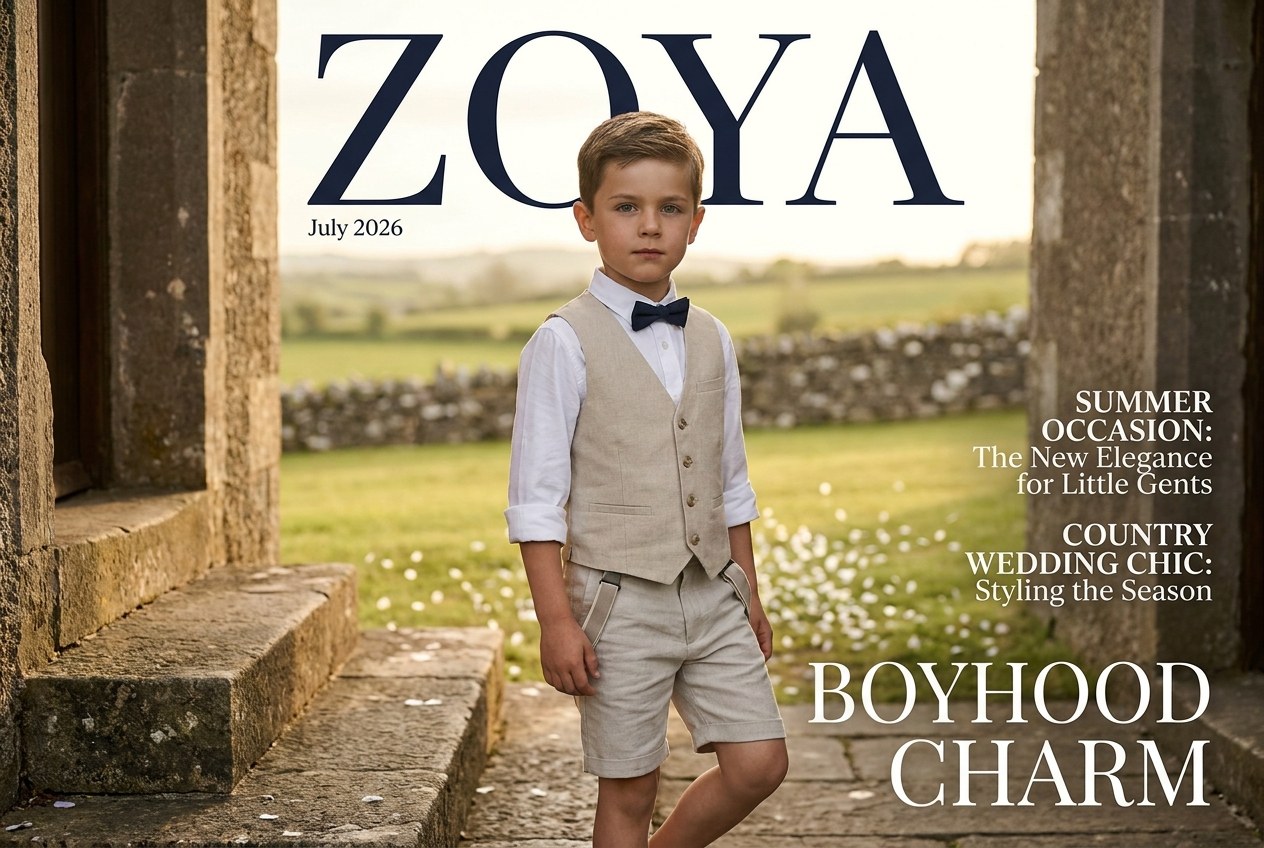
There is also a quiet dignity in the set that the borrowed suit never achieves. A boy in a linen-blend waistcoat, a soft-collared shirt and tailored shorts looks like a child who was dressed thoughtfully for an occasion. A boy in a three-piece two sizes too large looks like a child who was dressed to fill a gap in a photograph. Which of those two do we actually want in the album in twenty years?
Holding the Category to the Girls' Rail Standard
Here is my proposal, and it is not a radical one. Apply the exact criteria we already apply to occasion dresses. Nothing more, nothing softer.
Fabric first, always
The girls' rail is interrogated on fabric with real rigour: cotton content, lining quality, how a tulle layer behaves against skin. The boys' rail is rarely interrogated at all, which is how so much polyester ends up in Irish churches in July. Polyester does not fail in the shop. It fails during the meal, when the function room fills, the fabric stops breathing and a five-year-old goes scarlet at the collar. Look for cotton, linen blends, viscose with a genuine natural component, and lining you would happily wear yourself.
Fit that respects a child's body
Fit means the jacket or waistcoat sits at the natural waist, the armhole is generous enough for a hug without the whole garment riding up, and the trouser rise accommodates a tummy rather than pretending it is not there. Adjustable inner waistbands are not a luxury feature in childrenswear; they are the difference between a set that works for one afternoon and one that works for a christening in July and a family portrait in October.
Comfort as a design requirement
Comfort in children's clothing is not the enemy of elegance, and I am tired of pretending otherwise. Flat seams, covered elastic, buttons that a small hand can manage alone, shorts as a legitimate formal option rather than a compromise. When you browse coordinated boys sets, the pieces that pass this test are obvious within seconds: they hang softly, they move, and they do not look like they are holding their breath. That is the standard the girls' rail already meets. Why should the boys' rail be graded on a gentler curve?
An Irish July Is a Test, Not a Backdrop
July in Ireland is the busiest and least predictable month in the occasion calendar, and it exposes weak clothing with real enthusiasm. The schools have been closed since the end of June, so the whole family is available and the invitations arrive in clusters. Wedding season is at full tilt, christenings are stacked into Saturday and Sunday afternoons, and half the country is trying to fit a photographer, a hotel and a set of grandparents into the same fortnight.
Then there is the weather, which deserves its own paragraph. An Irish July day does not commit to anything. It can offer you twenty-two degrees on a hotel lawn in Kerry at two o'clock and a stiff Atlantic breeze at four, and it will do this without warning or apology. The consequence for clothing is straightforward: you need layers that are genuinely separable. A set gives you that. Waistcoat and shirt for the church, jacket added for the photographs on the steps, jacket abandoned entirely by the time the band starts. A one-piece heavy suit gives you a single decision made in the morning and regretted by teatime.
The Irish reception adds its own demands. Our celebrations are long. Ceremony at one, photographs until four, meal at five, dancing until an hour no child should legally witness. A garment that is merely acceptable at two o'clock has ten more hours to prove itself. This is precisely why I keep pointing parents towards smart boys sets for the summer season rather than a single rigid suit: the set is a small wardrobe with an internal logic, not one garment doing an impossible job.
One more local reality worth naming. Irish families coordinate siblings more than most, and the sibling photograph is a fixture of the day. When the girls' outfits have been considered in detail and the boy's has not, the photograph tells on you. Coordination is not about matching colours exactly; it is about matching the level of care.
The Critic's Verdict: Five Points Before You Buy
I promised an argument rather than a list, but a critic who cannot land her case in five points is simply enjoying the sound of her own voice. Here is the summary.
-
Reject the size-up habit. Buy for the body in front of you and accept that a set worn well for one summer beats a suit worn badly for two. Sizing is where most Irish occasion outfits go wrong before the fabric ever gets a chance to.
-
Read the composition label with the same suspicion you bring to a dress. Natural fibres for a July church, always. If you would not put your daughter in that lining for four hours, do not put your son in it either.
-
Choose separates that were designed together. A set is not simply a bundle. The value is in shared proportion and shared fabric weight, which is what makes the pieces work individually afterwards. The waistcoat should earn its keep at a birthday party in September.
-
Accessorise with the same care as the girls' side. Braces, a soft bow tie, the right shoes. Our guide to boys' accessories covers the details that turn a good set into a finished look, and the family photo session guide is worth reading before you book the photographer rather than after.
-
Judge the outfit at hour six. Not in the mirror at eleven in the morning. At hour six, when the meal is over, the shoes are off, and the child either still looks like himself or does not.
The set was never the compromise. The borrowed miniature suit was, and we simply stopped noticing because it was traditional. If Irish parents applied to their sons' occasionwear even half the scrutiny they already apply to a communion dress, the category would improve within a season, because retailers respond to demand far faster than they respond to criticism. Start that demand this July. Browse the full range of Boys Sets at ZOYA, pick the pieces that pass the fabric, fit and comfort test, and let the next photograph on the church steps show a boy who was dressed with as much thought as his sister.
Read also:
- How to dress a boy for a wedding?
- Top Accessories for Boys: Style Ideas for Every Occasion
- A family photo shoot with a photographer - what should children wear to make the photos look beautiful?
- Elegant Christening Dresses for Girls: A Style Guide
- 5 Essential Occasion Dresses for Irish Girls' Capsule Wardrobe